This year to celebrate National African American History Month in February, I am going highlight a new series on my blog. This year, I will feature African Americans during the Golden Age of Radio - or Old Time Radio - during the 1930s through the 1950s. I wanted to start this blog last year, but alas...better late than never. I hope to have a great assortment of programs that showcase the great contributions of African Americans in mainstream radio when Jim Crow laws, segregation and discrimination were regular obstacles facing artists of color. For my first entry in this series, I will showcase a great series called Destination Freedom that broadcast from Chicago's WMAQ and featured biographical portraits of noted African-Americans in all fields.
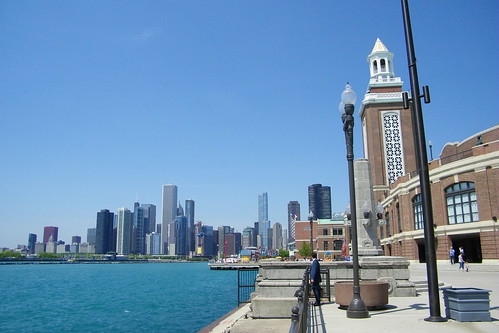
Chicago from Navy Pier (May 2012)
Destination Freedom is a series that ran over Chicago's WMAQ from June 27, 1948 through August 13, 1950. According to John Dunning's Encyclopedia of Old-Time Radio, "its original purpose was to dramatize and reveal little-known lives from black Americana. The show was the brain-child of Richard Durham, a black writer who also wrote scripts for the Works Progress Administration. This anthology series showcased biographies of notable members of the African-American community all over the country. The program had great production values and broadcast weekly on Sunday at 5pm. Early episodes were also produced with the Chicago Defender, the African-American newspaper of Chicago.
On September 26, 1948, Destination Freedom aired "Shakespeare Of Harlem", the story of poet Langston Hughes (1902-1967). The story starts out with young Langston heading off to Mexico to live with his father, who is a successful rancher. But rather than following his father into business, he wanted to write and was well known as the boy with a notebook. So despite the discrimination waiting for him back in the states, he decided to leave Mexico and head back to the United States. He worked a variety of jobs, but it was a chance meeting while a busboy in Washington D.C. that he was discovered. He slipped a poem to the attention of poet Vachel Lindsay and from that, his life as an obscure writer ended. Excellent radio historical account in this wonderful recording. Including in the episode are excerpts from Langston Hughes work including: "Freedom Train", "Suicide Note", "Wake", and "Democracy", all used with special permission by the author. Fred Pinkard played Hughes and the script was written by Richard Durham and produced by Homer Hecht.
For my 16th entry in my lighthouses on old time radio series, I will feature an episode of "Look What We Found" - a series from the Minnesota School of the Air. This is a great interview, we learn more about one of the most beautiful lights that protects ships in the Great Lakes. The Split Rock Lighthouse that sits high on a bluff over Lake Superior, just north of Duluth.
I am going to take a break from these episodes next month, while I focus on entries from a new series that will celebrate the radio contributions of African Americans in celebration of National African American History Month. After that, I want to return to my series of baseball on old time radio and even feature a brief series on Alexander Hamilton!
Cross Stitch Split Rock Lighthouse - Completed by the author around 10 years ago
The Minnesota School of the Air was one of the longest running schools in the United States. (For a great overview of these educations radio programs, check out William Bianchi's Schools of the air : a history of instructional programs on radio in the United States (2008). The program started at the University of Minnesota in the late 1930s. The goal of these programs was to supplement the education students were receiving in the classroom. These were broadcast over air from the stations at the University of Minnesota. From 1949 to 1950, the show Look What We Found was broadcast on Tuesday morning at 11am with an audience expected to be grades 4th through 8th. While we do not know when this episode aired, it likely came over this time period.
The episode of Look What We Found that I am focusing on today features Robert E. Bennetts and is called "A Lighthouse Keeper." Bennetts was the last civilian keeper of Split Rock from August 13, 1947 through 1961. Split Rock is a stunning lighthouse that sits high above the waters of Lake Superior.
The lighthouse was built in 1910 and serves as a protector of the shipping lanes that head to and from the great inland port of Duluth. This 15 minute episode is really quite nice to hear the voice of a lighthouse keeper. He is interviewed and asked questions about the lighthouse service and the history of Split Rock. What was most interesting are the personal questions asked to Mr. Bennetts. He had been a keeper for 26 years for the Coast Guard and he actually grew up in a lighthouse family, so his experience goes much longer than that. He also talked about the duties that are required like repairing equipment and cooking. One other interested element was him talking about the tourists that come to the lighthouse in the 1940s. There is another entry that I will showcase when I come back to this series that features a keeper in his own words. I hope you enjoy this and my next series.
For my 15th entry in my lighthouses on old time radio series - I am returning to Cavalcade of America. I have highlighted two previous entries from Cavalcade in this lighthouse series: Woman on Lime Rock (1947) & When Cupid Was a Pup (1949). This episode is the third (and last) Cavalcade episode that focuses on lighthouses. This episode goes back to the early years of Cavalcade and showcases some of the changes that made this a very successful program over the years.
The Cavalcade of America is a great series sponsored by DuPont. The purpose of the program has been one of great study and I am definitely glad that I have a few episodes to talk about it. The long-running show ran from 1935 to 1953 and then had a second life on television. Starting first on the CBS Network, it moved to NBC in 1939. This 30 minute program provided a great platform to showcase some of the lesser known incidents and people who made the country great. Not only was this series a great source of historical dramas, there were numerous fictional stories brought in as well. From the Internet Archive page (see link below), "The company's motto, 'Maker of better things for better living through chemistry,' was read at the beginning of each program, and the dramas emphasized humanitarian progress, particularly improvements in the lives of women, often through technological innovation."
According to John Dunning's On the Air: The Encyclopedia of Old-Time Radio (1998), the episode I am featuring today was special in the early history of this amazing series. (p.141).
The show was conceived in vignette form, with two or more separate-but-related stories making up the half-hour. The first show, No Turning Back, told in its two segments on the return of the Mayflower and of the great grasshopper plague. The Spirit of Competition, the third show, told the stories of the Oklahoma land rush and the Mississippi steamer race. So it went, week after week. But this format had one glaring weakness: a lack of continuity due to the brevity of each segment. Before a listener could become interested, a story was finished and a new one begun. This broken-show format was continued for a full season, liming along in low single digits in the ratings. It wasn't until the third show of the second season (Sentinels of the Deep, a story of the lighthouse service) that the broken shows were discontinued.
On October 14, 1936, Cavalcade featured a story of bravery, heroism, and the selflessness shown by those who have worked in lighthouses and lightships to keep us safe. After the orchestra played Rimsky-Korsakov's Scheherazade (selections from the 4th movement), the actors portrayed three stories showcasing the history of this great service:
Early in the 18th Century, the perils of arriving at Boston Harbor before 1716, when the first lighthouse was established in North America.
The price a keeper's family has to pay during the winter. A keeper, his wife and their young son just about lose patience awaiting a supply ship. Should their last oil be used for the light or for heating.
The difficult life on-board a lightship. In this story, crew men on the Lightship Nantucket are scrambling for their life after being hit and sunk during a foggy day (May 15, 1934). This took place less than three years before this episode aired. If you follow the link above, you will see how many vessels were called the Lightship Nantucket.
The brave men and women who work in lighthouses and lightships owe our eternal gratitude for their service keeping us safe. I love this episode for showing not only their service, but that of their family. I hope you enjoy this great episode from Cavalcade of America.
Lighthouse keepers have one primary job - to save lives through keeping ships from smashing into the shore. There are few professions that are as noble and virtuous. So when a lighthouse keeper starts killing people, there is a real problem. Oh, and did I mention that the keeper was already dead for over 150 years....! Who can solve this mystery and keep the ghost keeper from striking again?
For my 14th entry in my lighthouses on old time radio series - I am drawing upon a great series that is one of the most iconic voices from Old Time Radio. Few programs have as much recognition as the Mutual Network's The Shadow and their famous opening:
"Who knows what evil lurks in the minds of men....the Shadow knows!"
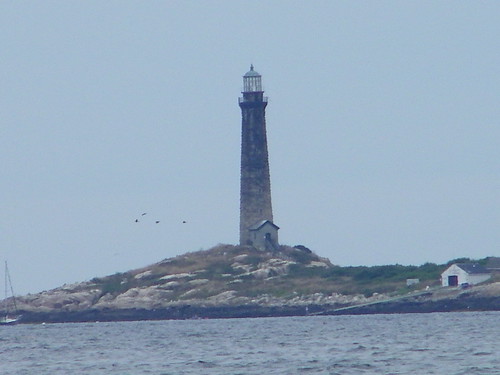
Thacher Island Twin Lighthouses (Cape Ann, Massachusetts) August 2010
The Shadow tells the story of Lamont Cranston, a 'man about town' who learned the powers of clouding men's minds while in Asia. Lamont turns into The Shadow when he needs to solve a crime and correct wrongs done by others in the name of greed and evil. The only one who knows that Lamont is also The Shadow is his companion, Margo Lane. The Shadow was the creation of writer Walter B. Gibson in 1931 and was serialized in magazines and pulp novels in the 1930s. It was adapted to radio early in the Golden Age of Radio and counted among those who voiced the lead character were Orson Welles, Bill Johnstone, Bret Morrison, John Archer, and Steve Courtleigh. It seems that the characters and plot lines from both pulp and radio helped change both formats as The Shadow remained a prominent element of popular culture into the 1950s.
On September 7, 1947, the Mutual Network broadcast "The Phantom Of The Lighthouse." An elderly lighthouse keeper, his wife and his assistant are sitting in a dimly lit room in a lighthouse as the episode opens. The keeper's wife is reading from the the diary of Josiah Blake, the 'master of this lighthouse' along the coast of Maine. Blake had died 150 earlier and threatened anyone who would take the job as keeper of that light. When the keeper's assistant falls off the tower to his death, the keeper's wife declares that it is the ghost of Josiah Blake that did the deed! Not only did he declare himself the 'master of the lighthouse,' but he was also a pirate who killed many in his day. A ghost killing those who work at a lighthouse? Sounds like a job for Lamont Cranston and Margo Lane to take. And when the ghost claims another life (the old keeper), it seems to be a mystery that only the Shadow can solve. There are secrets that need protecting and a fortune to find. The episode stars Bret Morrison as Lamont and Grace Matthews as Margo. The show also stars radio great Santos Ortega in the supporting cast. The show is sponsored by Blue Coal - the best anthracite for your home heating needs. I hope you enjoy!
For my 13th entry in my lighthouses on old time radio series - I thought I would stick with the 1930s and feature a series that I have not used before. In fact, I have not featured many programs that are shorter than a standard 30 minute time-slot, but this fits that bill also. There is not a ton written on this series - so thee is a good incentive to keep digging! With that all said - on to the show.
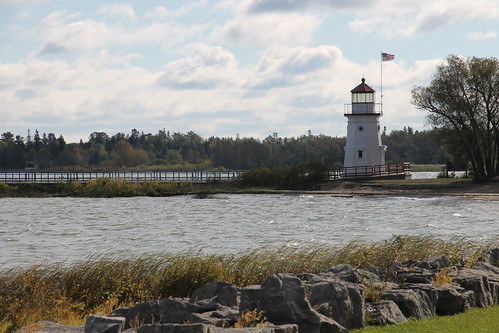
Cheboygan (Michigan) Crib Light (Lake Huron) October 2015
Front Page Drama was a 15 minute weekly serial that ran from the mid 1930s through at least 1954. This series had a very specific function. The series presented a dramatization of a story that would appear in the Sunday newspaper supplement called the American Weekly. This supplement was placed in the Sunday editions of Hearst newspapers across the country. In the mid-thirties, the series would be on more than 230 radio stations across the United States, Canada and Australia (according to Variety on March 13, 1935 - p41). To get a sense of the series, here is a review for an episode in Variety in 1937:
Waxed dramatization of story 'to appear in next Sunday's American Weekly' air over WMCA and approximately every station in the New York area, with the exceptions of WEAF, WJZ, WABC and (currently) WOR - about 20 stations at present. Waxing and placing them handled by Tom Brooks, radio editor of Hearst's N.Y. American and Journal. Understood broadcasts are gratis proposition, for 'good will.' Brooks is doing okay.
Program caught (20) told hokey meller about prodigal son just out of the pen and nose-diving back into crime. Yanked back to the straight-and-narrow by a mystical 'traveler' he tried to hold up. Winds up with the reformed lad back with his poor old mamma. Hefty trending on the tremolo pedal and beaucoup serving of sugarcoated pills of philosophy. Actors do what they can with it. Instrumental backgrounds of explanatory interludes and commercials.
Possibly readers who would go for type of yarn broadcast would buy the American as a result of this program.
-Hobe. (Variety - Wednesday March 24, 1937, p39)
On February 15, 1936, the featured story from the upcoming American Weekly was called The Devil's Crib. Think of it a bit like Romeo and Juliette on a lighthouse. Well, not really, but there are two families - especially the patriarchs, who cannot stand each other. One is the lighthouse keeper on Devil's Crib - the other a ship captain. Unknown to either of them, their children fall in love. Outrage ensues when the lighthouse keeper reveals that the ship's captain called him an 'old stick in the mud.' I guess that constitutes one of the worst things you can call someone over the radio in 1936. But when the weather unexpectedly gets worse, these two adversaries, with a bit of supernatural help, find a way to help each other out. Hope you enjoy this short program from Front Page Drama.
Its 2017 and I just had a great time sharing old time radio recordings about Christmas for the third year ( Here is a link to all the previous OTR Christmas entries). That got me thinking that I never finished up my radio series about lighthouses last year. So no better time than the present to finish up these great Old Time Radio programs with a lighthouse theme. I hope to have these every few days - maybe twice a week. Here is the 12th entry in my lighthouses on old time radio series - but my first in 2017. Last year, I featured Lightship was on the CBS Radio Workshop. The CBS Radio Workshop was a later take on their brilliant series, The Columbia Workshop.
>
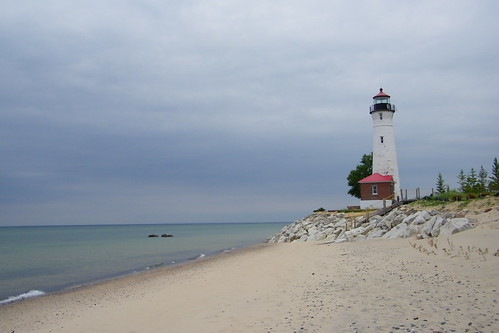
Crisp Point Lighthouse (Lake Superior) July 2011
The Columbia Workshop was a staple of the CBS Network from 1936 through 1942 and from 1946 through 1947. According the Rob Lackmann's Encylcopedia of American Radio, the Columbia Workshop was designed "to develop new writing talent for radio and to experiment with innovative techniques for presenting drama on the medium." One of the most creative voices from the Columbia Workshop was Norman Corwin, who served as the director and producer for this great episode.
For the episode on September 29, 1938, The Columbia Workshop did something that it had not done before. In the spirit of experimentation, they chose to dramatize Paul Cloquemin's thriller, "The Lighthouse Keepers." They performed this episode with only two actors, Ray Collins who plays the father and Luis Van Rooten who plays the son. Taking place on a stormy March day at the Maudit Lighthouse near the coast of Brittany. Maudit means cursed or damned in French. The two people on the lighthouse are the aged keeper (Brehan) and his son Yvon. The storm forces them to talk about duty and fear. The need for these lighthouse keepers to act heroically, even when their own lives are at risk. Complicating matters is that Yvon was recently bit by a dog - and has become rabid. The father had only one way to take care of his son.
The original play on which this episode is based comes from the Grand Guignol theater where it was first performed in 1913. This was a Parisian theater from the 19th century that specialized in horror stories. As the story proceeds, it is as scary as anything you can hear on radio. I hope you enjoy this great episode from the Columbia Workshop and enjoy my new lighthouse entries.
As we have reached the 25th Day of my Old Time Radio blog celebrating Christmas, we are at my other favorite episodes - or series of episodes: The Elgin Watch Specials. These 2 hour shows are too long to be broadcast on Greg Bell's Old time radio channel (#148), but are simply the best part of the holidays for me, especially if you are cooking in the Christmas. Here is a link to all the previous OTR Christmas entries.
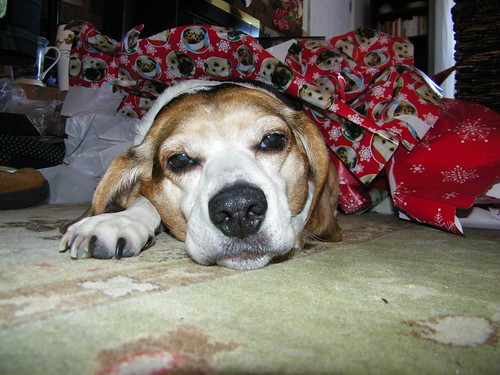
Flapjack my beagle - Christmas 2012
One of the really cool shows I stumbled onto a few years back were the Elgin Seasonal Specials for Thanksgiving and Christmas in the 1940s. These were also known as Elgin's "2 Hours of Stars." The shows were sponsored by the Elgin Watch Company of Elgin, Illinois. Starting in 1942 for the soldiers overseas, the Elgin Holiday Specials were two hour programs that featured the brightest stars in radio and the movies. Heard on these programs is Bing Crosby, Mario Landa, Jimmy Durante, Bob Hope and were all hosted by Don Ameche. The Internet Archives has five total shows (see the link below). One of the real treats takes place one hour into the show from 1945. Jack Benny gave a twisted performance of Sorry Wrong Number, one of the most iconic episodes of Suspense. Also, given that the program runs 2 hours, these are not commonly played on current radio programs like XM 148.
I read that the specials had very different purposes. The Thanksgiving shows were to get you to think about Elgin Watches and accessories for Christmas gifts. The Christmas shows were to get you to think about Elgin Watches as you cashed in your gift certificates that you might have received for the holidays. Variety reported in June 1949:
Shows last year cost Elgin an estimated $100,000 each, of which $26,000 went for network time and $60,000 for talent. First program to get the axe was the Christmas package, which was aimed at coaxing recipents of gift certificates into post-holiday buying of timepieces. Last year's January business, however, was reportedly so far from expectations that the watch company figured it has a white elephant on its hand. J. Walter Thomson agency made a fight to save the plum, with no luck.
As a great variety show that lasts two hours, it is a perfect thing to have on your radio (or computer) as you cook the Christmas meal. It has been on the radio in my kitchen these last few years over the holidays. Though we are not cooking for Christmas this year, it is a regular for me and will be my go-to Old Time Radio program for both Christmas and Thanksgiving. I hope some day to write up something more in-depth on this program.
Here are links right to the Elgin's Christmas Shows:
Summary: The show features and all star list of radio and movie actors including: Ginny Simms, Eddie Anderson, Jack Benny, Louis Silvers and His Orchestra, Manny Klein, The Swing Wing, The Charioteers, George Burns, Gracie Allen, Carmen Miranda, Joseph Szigeti, The Les Paul Trio, Barbara Jo Allen, Bob Hope, and Bing Crosby. The great Don Ameche served as the master of ceremonies. I think it is totally great to hear any early performance by Guitar great Les Paul and his Trio! Bing Crosby also went off the Christmas script and sang "Don't Fence Me In." The routine between Bob Hope and Bing Crosby was fantastic as well.
The shows have great Christmas music, and some pretty funny comedy bits. I particularly enjoy the long skit between singer Ginny Simms, Jack Benny and Eddie Anderson about how they were rehearsing for this song on the Elgin special. The performance also by guitar great Les Paul is fantastic.
In the Variety Radio Reviews of the program (which appear in the December 27, 1944 issue - page 28):
This third annual Elgin Watch Christmas Day star-studded show was a boff companion piece for the company-sponsored Thanksgiving program-and that's another way of saying that you'll probably have to wait a long time (until, perhaps, Elgin shoots the works on another ultra-package) to match the 120 minutes of entertainment that went out over the CBS network from 4 to 6 p.m. And like the Thanksgiving show, this one not only went into the homes of the nation's Yuletide celebrants, but circuited the global warfronts.
Here was a Xmas package that couldn't but help momentarily gladden the hearts of those GIs holding down the battle line forts. As such it will stand as a tribute to Bob Hope-Bing Crosby-Jack Benny & Co. (and with due acknowledgement to the whole supporting cast); to the top scripting job sparked by Carroll Carroll and overall Tony Stanford production that combines a properly tempoed humor and hilarity with a complete awareness of the sensitivities involved in justifying a gay, laughing-at-home mood in contrast to the misery and tragedies that the boys overseas are encountering. It was to a large measure, that sensitively-wrought portion that helped make the show memorable, particularly in the treatment it was given by Don Ameche, who emceed the show (there ought to be a Society of the Promotion of Ameche as Permanent Emcee for Such Occasions), and in the Crosby windup spiel.
The show was well paced and marked by a proper integration of drama, comedy, music (both in the hot and longhaired idiom), all with dignity and, for the most part, in good taste, but essentially it was a show build for laughs - laughs to hypo GI spirits and those at home with a stake in the war via concern for sons, fathers, brothers, sweethearts. It was comedy with a purpose, and in paying the freight, Elgin contributed its own generous portion of extending the season's greetings.
Not that the program was without its imperfections. In keeping with that overall good-will-toward-men theme, those Elgin pitches could have been soft-pedalled; similarly the multiplicity of plugs to fie in the products of the guestars were overworked. There was, too, a middle-portion boggin down in which Carmen Miranda, in particular, came off second best.
But add up that wham Crosby-Hope latter portion routine with its spontaneity and warm, infections quality; that Jack Benny-Rochester-Ginny Simms fiddle accomp comedy stretch; the latter's sock renditions of "Hallelujah" and "Wish You Were Waiting for Me"; add, too, the Burns & Allen-Don Ameche laugh-packed skit, the Charioteers singing "Poor Little Jesus Boy," the Les Paul Trio doing "Danger - Men At Work," the hot routine of the Swing Wing (Mannie Klein) musical combo from the Santa Ana Army Air Base Band, the change in pace via Joseph Szigeti's flawless violinistics, and it's easy to understand why this Christmas package couldn't miss.
Summary: The show stars Don Ameche as the masters of ceremonies and a all star cast including: Jack Benny, Bob Hope, Ginny Simms, Red Skelton, Bob Crosby and The Bobcats, Barbara Jo Allen (as "Vera Vague"), Allan Jones, Artur Rubinstein, Ella Logan, Alan Reed, General Omar Bradley, The Charioteers, Larry Storch, and The Elgin Orchestra conducted by Louis Silvers.
Summary: The show stars Don Ameche as the masters of ceremonies and a all star cast including: Sandra Berkova. Lauritz Melchior, Al Jolson, Danny Thomas, Red Ingle, Jack Kirkwood, Jo Stafford, Edgar Bergen, Sandra Berkova (a 15 year-old violinist), Cass Daley, Ozzie Nelson, Harriet Hilliard, Robert Armbruster and His Orchestra, and Jane Morgan.
I hope you have a Merry Christmas, Happy Holidays and enjoy these wonderful recordings!
Here are some links to programs relating to the Elgin Watch Specials: