Tuesday, December 1, 2015

25 More Days of Old Time Radio Christmas: Day 1 - Honest Harold's Christmas Party

So here we go again...I want to create more blog entries for my OTR Christmas Series.  Last year - I went 29 days - and barely scratched the surface with great number of programs that are available.  Here is a link to all the 2014 OTR Christmas entries.

If you have Sirius/XM, you can listen to Greg Bell's Old time radio channel (#148).  He does a great job of showcasing great holiday themed episodes, especially as we get closer to Christmas and the end of December.  But with a fool's ambition, I am going to try to get an entry out a day.  I will probably miss one or two - but I will make up by the end of the month...that is the plan at least.
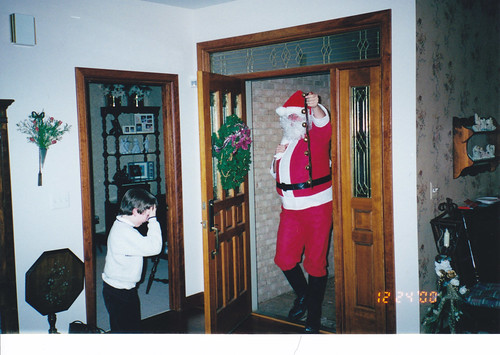
Facepalm (Christmas 2000)
Santa visiting in 2000.


Honest Harold is a classic radio comedy starring Harold Peary. In fact, it is often called the Harold Peary Show through its relatively short lived run in the Golden Age of Radio. It started in large part from a contract dispute that removed Harold Peary from his own show, The Great Gildersleeve. Gildy was a character that Harold Peary developed from a stint on the Fibber McGee and Molly show in 1938. By 1941, he had his own show, The Great Glidersleeve on NBC. This might be the first spin-off show. In 1949, he decided to leave NBC and join CBS. He tried to take his show with him, but Kraft would not let him go. So with this, The Great Gildersleeve stayed on NBC (with Willard Waterman taking over Peary's role) and he started a new show. It was was called The Harold Peary Show (or Honest Harold). The show only lasted one season (38 episodes). Peary plays a radio personality in a small town. His show is called (as you might guess) Honest Harold. From the Internet Archive: "The show was about an older, unmarried guy, Honest Harold Hemp, who lived with his mother and nephew and did a radio homemaker's program. The townsfolk think of him as somewhat of a celebrity, but his girlfriend, Gloria, who works at the station, knows better."


In this Christmas episode from December 20, 1950, Harold organizes his club's Christmas party for the town children. Harold wanted more than anything to be the Santa for the party. He even had to run in a club election to get it. When Harold won the right to be Santa Claus, he could hardly contain his enthusiasm. But when he met an old timer who wanted to be Santa, and needed some second and third chances, Harold had a change of heart. The episode ends with a lovely rendition of Oh Come All Ye Faithful from Peary. Before too long, I will have a Gildersleeve episode to share as well.


Here are some links to programs relating to The Harold Peary Show:

    25 Days of Old Time Radio Christmas (from 2015) & Other Links

    25 Days of Old Time Radio Christmas (from 2014)

    Wednesday, November 25, 2015

    Cooking with Don Ameche - The Elgin Watch Company's Thanksgiving Specials (Old Time Radio)

    On this day before Thanksgiving, I wanted to share a wonderful item that you can listen to as you are preparing your meal at home.  I will be doing the same. If you have Sirius/XM, you can listen to Greg Bell's Old time radio channel (#148). He has a number of great Thanksgiving-themed programs available this week. You can also get a large number of these programs at a variety or resources on the web.

    Scenes from John Wayne Airport (Orange County, California) - Sunday July 15, 2012

    One of the really cool shows I discovered a few years ago are the Elgin Seasonal Specials for Thanksgiving and Christmas in the 1940s. The shows were sponsored by the Elgin Watch Company of Elgin, Illinois. Starting in 1942 for the soldiers overseas, the Elgin Holiday Specials were two hour programs that featured the brightest stars in radio and the movies. Heard on these programs is Bing Crosby, Mario Landa, Jimmy Durante, Bob Hope and were all hosted by Don Ameche. These shows are a combination of songs, skits and other performances that capture the best of radio.  The Internet Archives has five total shows (see the link below). Also, given that the program runs 2 hours, Greg Bell does not schedule them on Radio Classics.  So that means if we are going to listen to these great programs, we need to be a bit more proactive!

     Here is a link right to the two Elgin Thanksgiving Holiday Shows on the Internet Archive:

    Elgin's 6th Annual Thanksgiving Show (November 27, 1947)

    Elgin Thanksgiving Day Greeting To America. November 27, 1947. CBS net, KQW, San Jose aircheck. Sponsored by: Elgin Watches. "The Sixth Annual Elgin Thanksgiving Day Greeting To America." The first tune is, "It's A Grand Night For Singing." Jimmy Durante and Garry Moore perform together for the first time "since getting shows of their own." "News Scoops From Hollywood," Candy Candido appears as "Mr. Ripple." Fifteen-year-old Mary Jane Smith sings. Sir Lancelot sings a calypso watch commercial! Larry Storch does impersonations. Margaret Whiting and Vera Vague join Jimmy Durante singing a clever original parody about a possible woman president (to the tune of "Feudin', Fightin' and Fussin'"). The Page Cavanaugh Trio sings a delightful Elgin commercial to the tune of, "The Lady From Twentynine Palms." Bob Sweeney and Hal March drive to the studio (don't ask them what an "Oh, For Goodness Sakes" sandwich is). The winners of the SPEBQSA competition sing barbershop harmonies. Yehudi Menuhin plays "Habanera" by Sarasate (accompanied by his sister on the violin). He then plays a duet with another violinist...Jack Benny! Artie Auerbach does an Elgin commercial as, "Mr. Kitzel. Cathy and Elliott Lewis are featured in a well-written story about a housewife's last day. Good radio! "A Child's Thanksgiving" features Red Skelton as, "Junior, The Mean Widdle Kid." After he says grace, Clem Kaddiddlehopper finds himself in one of the Elgin watch commercials! Allan Jones, Louis Silvers and His Orchestra, Jimmy Durante, Garry Moore, Candy Candido, Mary Jane Smith, Sir Lancelot, Larry Storch, Margaret Whiting, Barbara Jo Allen, The Page Cavanaugh Trio, Al Viola, Bob Sweeney, Don Ameche (host), Ken Carpenter (announcer), Hal March, The Doctors Of Harmony, Yehudi Menuhin, Jack Benny, Artie Auerbach, Betty Wright (writer), Cathy Lewis, Elliott Lewis, Red Skelton, Verna Felton, Lurene Tuttle, Pat McGeehan. 1:59:31. Audio condition: Excellent. Complete. (Line-up from the Radio GOLDINdex)

    Elgin's 7th Annual Thanksgiving Show (November 25, 1948)

    Elgin Thanksgiving Day Greeting To America. November 25, 1948. NBC net. Sponsored by: Elgin Watches. "The seventh Annual Thanksgiving Day Greeting To America." The first tune is, "Cosi, Cosa." Dean Martin is introduced as a promising "newcomer" and "a star of tomorrow." Don Ameche (host), Mario Lanza, Garry Moore, Jimmy Durante, The Mills Brothers, Barbara Jo Allen (as "Vera Vague"), Andre Previn, Bob Hopkins, Jack Benny, Frances Langford, Dean Martin, Jerry Lewis, Red Skelton, The Elgin Orchestra, Robert Armbruster (conductor), Ken Carpenter (announcer), Earl Levy (producer), John Christ (producer), Ed Helwig (writing supervisor), Frank Nelson, Artie Auerbach, Lurene Tuttle, Verna Felton. 1:58:54. Audio condition: Very good to excellent. Complete. (Line-up from the Radio GOLDINdex)
    In my house, I do much of the cooking and so I love to have these old programs playing in the kitchen.  This year, we are over at the in-laws, but we are making sides at our house.  So you can be sure that on Thanksgiving morning, I will be cleaning, cutting, cooking, etc. with Don Ameche and friends providing the entertainment and encouragement!  

    Here are additional Thanksgiving themed shows available on the Internet Archive:
    For more reading, check out my other Old Time Radio blog posts:

    Monday, November 23, 2015

    Old Time Radio - John Dehner Centennial Celebration


    CBS Columbia Square (Hollywood, Los Angeles, California) - October 31, 2013
    CBS Columbia Square in Hollywood, California (October 2013) .  This was the home of the CBS's radio studios in Hollywood.  More importantly, it was the home of Gunsmoke and other leading programs from the network.
    Today we celebrate the centennial of one of the most prolific actors from the golden age of radio: the great John Dehner.  On November 23, 1915, John Dehner was born in Staten Island, New York.  John Dehner was not only a regular on radio programs, but was also accomplished on both television and film.  But surprisingly, there is relatively little written about him.

    According to his obituary from the Washington Post (published on February 10, 1992, six days after his death in Santa Barbara, California), they pointed out that he was educated in Paris and served as an animator with the Walt Disney Company after entering show business through the stage in New York.  At Disney, he worked on Fantasia and Bambi among other projects.  Like so many men during the 40s, he served in the U.S. Army during World War II.  Upon his return to civilian life after the war, he started his career in radio.

    According to the RadioGOLDINdex, John Dehner appeared in 874 programs.  To put this in perspective, big names put up big numbers of programs.

    • Joseph Kearns (1160)
    • William Conrad (1141)
    • Robert "Bob" Bailey (709)
    • Howard McNear (1000)
    • Lawrence Dobkin (917)
    • Jack Webb (463)
    This is really nice company.  

    I wanted to showcase a few episodes that I love from John Dehner.  There are a lot to choose from.  Of the 480 Gunsmoke episodes, John Dehner appeared in 223.  And almost always, he was the mysterious villain.  When my wife and I are listening to Radio Classics on XM 148 and we hear John Dehner on Gunsmoke - we are pretty sure he is the bad guy!

    Dehner has such a distinct and sophisticated voice.  He often played the elder statements, the aristocrat, or the dignitary from another country.  He was a mainstay in the stable of actors that were called on regularly for CBS where great programs were being produced through the early 1960s.  I am sure that he was a regular at the studio above and that everyone there knew his name.  If they did not know his name, they certainly would have recognized his voice!

    While mostly a supporting character, he was given two shows on CBS where he was the star.  One will be featured below (Frontier Gentleman).  The other is Have Gun Will Travel, where he played Paladin.  I am still trying to get into this series - it is just not my favorite.

    The Librarian (From Frontier Gentleman - October 5, 1958)

    The Frontier Gentleman was a late radio series from CBS that starred Dehner as J.B. Kendall, a correspondent from the London Times who traveled to the American West.  This is the opening of the series (which would run from February through November, 1958):

    Herewith, an Englishman's account of life and death in the West. As a reporter for the London Times, he writes his colorful and unusual accounts. But as a man with a gun, he lives and becomes a part of the violent years in the new territories. Now, starring John Dehner, this is the story of J. B. Kendall, Frontier Gentleman...
    The story called "The Librarian" finds J.B. Kendall meeting a widower who moved to the territory out west with her husband who recently died.  The woman, who was a librarian, found herself back at her house after traveling east to get medical treatment for her husband.  Even though he died, she returned to the land to honor his sacrifice.  What she found was a claim jumper, a Confederate soldier who was not interested in leaving the land.  J.B. Kendall works with a local posse to get the claim jumper off.  The group disbands when the librarian reports that the claim jumper had left.  But did he?


    The Constable (From Gunsmoke - May 8, 1954)

    Gunsmoke is one of the series that hardly needs an introduction.  It started in 1952 as a western series for adults.  So popular, it spawned a television series and lasted on radio until 1961. This episode has always been one of my favorites.  John Dehner joins the Gunsmoke regulars as Rantz, the head of a a Texas cattle herd that just came into Dodge.  The episode opens with Chester and Matt Dillon talking about how they took care of rowdy cowboys that rode into Dodge that day.  Rantz threatened to not return to Dodge City and that made the business leaders nervous.  The business leaders gathered to encourage Marshall Dillon to go easy on the cowboys - they cannot afford to lose the business.  When the business leaders hire a Constable and tell Marshall Dillon to leave the cowboys alone, chaos is the word of the day in Dodge.  Only the strong hand of Marshall Dillon can restore order.


    The Laughing Matter (From Yours Truly, Johnny Dollar - June 11 through 15, 1956)

    If anyone knows my tastes of Old Time Radio, you know I love Yours Truly, Johnny Dollar.  I especially love the multi-part episodes that ran from 1955 through 1956 when Bob Bailey became the star and title character of the show.  These five part marathons are a staple of XM 148 - Radio Classics with host Greg Bell.  The best part of these multi-episode stories is the ability to expand the plot and dig deeper into the characters.  The conversations are more revealing and are less driven by exposition to get points out in a short program.  These stories typically cover 75 minutes and that is fantastic for some of these mysteries.

    John Dehner was in a number of Yours Truly, Johnny Dollar episodes as a big actor at CBS (where that was recorded).  In the Laughing Matter, John Dehner plays Actor and Comedian Charlie Burton - who is in Mexico where he life was threatened.  Turns out, the problem is not finding someone who wants to do in 'lovable Charlie Burton,' but finding someone who DOESN'T want to kill him!  

    Wednesday, September 23, 2015

    My Favorite Yogi Berra Story

    We learned this morning that Baseball Hall of Fame Member Yogi Berra passed away at age 90.  And while living to 90 is great in anyone's book, Yogi Berra's passing will make so many people sad today because he was a truly great person who make you feel better just knowing him.  The kid who grew up in the shadows of the St. Louis Cardinals, became of the iconic members of great New York Yankee teams in the late 1940s, 1950s and early 1960s.  He was an active player on 10 World Championship teams (all with the Yankees) and would also coach on three others (the 1969 Mets and two Yankee teams).  And while you would never say that he was as good a ball player as the Yankee greats Babe Ruth, Lou Gherig, Joe DiMaggio, and Mickey Mantle, none of them (I suspect) could hold a candle to Yogi's warmth and charm as a person.


    Scenes from The Otesaga Hotel for Hall of Fame Weekend (Cooperstown, NY)
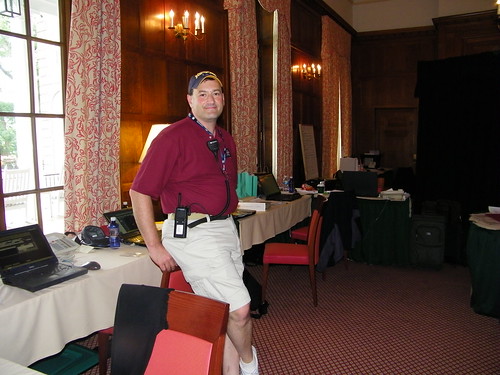
    Looking so young at Hall of Fame Weekend in 2009 - my last year on the Hospitality Crew
    From 1996 to 1998, I was fortunate to work at the National Baseball Library of the National Baseball Hall of Fame in Cooperstown.  I was the head of technical services for the library, managing the development of the ABNER online catalog and also building the archival collection.  It was a great two years that I will always treasure.  The big event at the Baseball Hall of Fame was the the induction of new members of the Hall.  This takes place at the end of July and involves all people who work at the Hall to take on a new responsibility for that weekend.  As someone who was good with databases and computers, I was assigned to the Hospitality Suite at the Otesaga Hotel.  This is the beautiful resort hotel in town that serves as the headquarters for the Induction Weekend events.

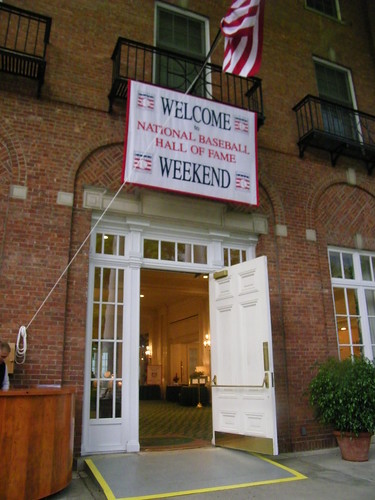
    Scenes from The Otesaga Hotel for Hall of Fame Weekend (Cooperstown, NY)
    Otesaga Hotel over Hall of Fame Weekend, 2009
    Working on the Hospitality team was great.  We were right in the middle of the activity and we had the ability to interact with the special guests and Hall of Famers.  However, even in the time before selfies - we were very careful never to ask for autographs (it was against Hall rules - you would be fired), or pictures, or really anything.  We were there to serve.  The role of the Hospitality Desk changed just before I got there - and the focus was places squarely on our role and purpose to make things right.  To this day, a great deal of what I believe in running a library comes directly from my time on the Hospitality Desk.  Though I left the Hall in 1998 to move to Michigan, I came back to work Hall of Fame Weekend every year from 1999 to 2009.  Those were wonderful years.

    My favorite Yogi story....actually, I am pretty proud of myself for this.  I remember one of the crew shaking he head early one morning after he ran into Yogi who asked him when the 7am breakfast was going to take place.  We all had those moments.  He was genuine and lovable.  He was always nice and pleasant to the Baseball Hall staff - especially the Hospitality crew.  But more than that, he was one of the most recognizable Hall of Fame members alive.  Through all his television and commercial work, practically no one there would not recognize him immediately.

    I believe it was during the 1998 Induction, that Yogi Berra won an award from the Hall of Fame Classic, the golf tournament that takes place the morning of Hall of Fame Induction day.  You win overall awards for lowest score (typically by age bracket) and there are clubs that are given for a few different "closest to the pin" holes.  He had one one of them.  The members were told that they should come to the Hospitality Desk and pickup there prize.  I was working at the desk and was feeling a bit punchy when he came up.  He said hello and that he won a golf club.  I got up and went back to where they were, pulling the one that said Yogi.  I came up and noticed that he did not have his name badge on.  Not sure why I said this - but it was worth it.  In a very serious way, I said something to the effect that "Sir, this golf club is for Yogi Berra.  But I do not see your name tag, do you have any identification I could see?"  He looked at me with a dumbfounded look on his face.  He could not believe anyone did not know who he was.  He did not have any ID, but everyone knows Yogi! After a few seconds of fumbling around looking for something, I said that I could give it to him, but I hope my manager does not yell at me.  He smiled at me and took his club away.  I am pretty sure he knew I was joking.  

    I am not sure that would have worked for any other Hall of Famer.  He was famous, yet always had a modesty about him that made him a pleasure to be with.    Rest in Peace Yogi. Thanks for all the memories and the love you shared for this great game of baseball.

    Friday, July 3, 2015

    The Human Side of the National Game: The Addie Joss Benefit Game of 1911


    October Day at COSI (Toledo, Ohio)
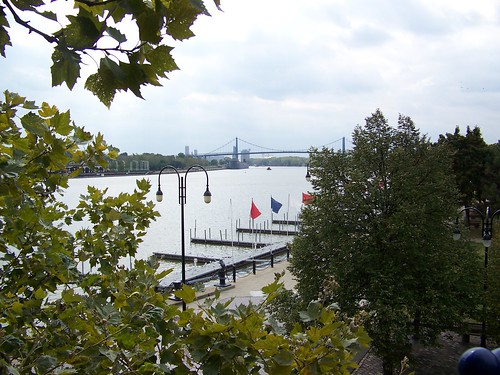
    Toledo Ohio (and the Maumee River in 2007)


    NOTE: This is an article I wrote for Toledo Streets Newspaper in 2003.  This social enterprise describes itself this way "we're a street newspaper sold on public property by men and women in poverty situations, like homelessness. We provide these self-contracted workers with a product to sell, as well as job training, skills development, enrichment and educational opportunities, and networking for further growth."  I am not sure that this ever found its way to the web.  I came across the working notes for this article when I was cleaning up - so it gave me the idea that I should recycle the notes (lighten my load) and post the article to my blog (spread the word).  It kinda rhymes.  

    The Human Side of the National Game: The Addie Joss Benefit Game of 1911
    Corey Seeman (May 2013)


    The nature of fame is truly fascinating.  In all walks of life, true fame is built day by day, slowly over time.  In sports, notoriety can come from one amazing game or one amazing season, but fame – true fame – can only come from game after game, month after month, and season after season.  For athletes, the attainment of fame occurs long after they hang up the cleats, put down the bat, or otherwise drift off into the sunset.  


    In baseball, when people think of the greatest pitchers who ever stared down a batter from atop the mound, they might list off Christy Mathewson, Walter Johnson, Sandy Koufax, Bob Feller, Bob Gibson, Cy Young, and so on.  These are the names that need little explanation to most baseball fans.  Come to think of it, even people with only a passing knowledge of baseball has heard of most, if not all of these greats.  For these men, their careers were long and distinguished such that there was never any doubt when they retired that they have accomplished what few others had.  But that is not the case of all athletes, many of whom succumb to a career shortening injury that leaves them on the cusp of true greatness.  Some face tragedy on the way and only accomplish a fraction of what they might have done should the fates had been on their side.  Such was the case with Addie Joss…one of the greatest pitchers you might never have heard about.


    Addie Joss, as a pitcher, dominated an era like few others have ever done.  Sadly, his era ended too soon, passing away two days after turning 31 in Toledo, Ohio.  Joss pitched for the Cleveland Indians (then called the Naps for their manager Napoleon LaJoie) from 1902 through 1910.  In those 9 years, he won 160 games, lost only 97, won 20 games four consecutive years and had a lifetime ERA of 1.89.  On October 2, 1908, he tossed a perfect game vs. the Chicago White Sox, winning 1-0.  Two and a half years later, Joss would die because of tubercular meningitis – an illness like his fastball, no one saw coming.  The Chicago Daily Tribune even reported that Joss’ mother, who was dispatched from her home in Wisconsin upon hearing of his illness, “…fainted upon noticing the wreath on the door.”  Like all tragedies, he was taken too soon.


    The shock of his passing was felt not only in his adopted home city of Toledo, where he had played two seasons of minor league baseball, in Cleveland, where he starred for the Naps, but all across baseball.  Evangelist Billy Sunday, who was in Toledo at the time of Addie’s death, provided the eulogy at his funeral.  Of the things Sunday said that day, one thing rings so true:


    “No more will the umpire walk in front of the grandstand and cry out: ‘the pitcher for Cleveland will be Joss.’  No more will the opposing club turn pale, for in the past they realized this announcement was the harbinger of almost sure defeat.  The name of Joss has always brought terror to the opposing nine.”


    Joss is buried at Woodlawn Cemetery in Toledo.  It is so appropriate that he lay to rest in his adopted home town where his baseball career began and where he served as Sunday sports editor for the Toledo News Bee.


    Joss had earned a very respectable $5,000 a year in 1910.  However, it was very clear to Addie’s team mates that his family needed some assistance to deal with the giant hole created with Joss’ passing.  Shortly after his passing, the Cleveland management and his former team mates decided to do something special for the family.  The idea was that the Indians would find an open date on their schedule and play a benefit game against all-stars from other teams to raise money that would go to the family.  While benefit games were not uncommon, this was the first one setup to include an all-star game and where the proceeds went to one family.  The date settled up was July 24, 1911 and what a day it was.  The all-star team featured eventual hall of famers Tris Speaker, Eddie Collins, Ty Cobb, Home Run Baker, Walter Johnson, and others.  The game itself was not spectacular, but the outcome certainly was.  The people of the City of Cleveland purchased over 15,000 and raised nearly $13,000 (with no money taken out for expenses) for the Joss Family (Lillian and their two children, Ruth and Norman).  In September 1911, Baseball Magazine wrote in their editorials powerful words about the event that place it in its proper perspective.


    The benefit day at the Cleveland ball park in grateful memory of Addie Joss was a touching and beautiful instance of the human side of the national game.  The Cleveland owners freely gave the use of their park, the Cleveland team offered their services gladly, while scores of star players throughout the league vied with one another in their efforts to secure a place on the opposing team and thus show some slight token of their esteem for a fellow player who had passed away.  In short all the varied interests of organized baseball united in the noble purpose of giving such assistance as lay in their power to the bereaved family of a man who was universally beloved.  


    This tremendous game not only served as a precursor to Baseball’s All-star game (which started in 1933 as an annual mid-season classic), but established a role for baseball to play in supporting those who had given their life to the sport.  Over the years, many events would kindle the fires of humanity that swept through Cleveland in the summer of 1911.  But in thinking of the Joss benefit game, it is clear that the management and players of the Cleveland Naps (as well as those who would also contribute) were responding to a higher calling.  This generous gift to the Joss family would enable fans in Cleveland to say thank you one last time.  On January 14, 1913, the Cleveland Press would write that the Joss Children are “Fine and Happy”, though Norman, who was in the 5th grade at the time, was playing football, not baseball like his famous father.  

    In 1978, the Directors of the Baseball Hall of Fame and Museum waived the rules that governed election by the Committee on Baseball Veterans that restricted consideration to those who played 10 seasons.  The Hall Directors allowed Joss to be considered despite the fact that he played only nine seasons.  On August 7, 1978, Joss’ cousin Dr. William Swartz would thank the Hall’s Veteran’s Committee for “…their favorable consideration of Addie’s credentials.” And while Addie Joss left this world too soon, this act placed a capstone on his remarkable career.  Like all that preceded him in Cooperstown and those who came after, it was clear that his fame was built one game at a time – enabling us to step back and be amazed at not only his accomplishments on the field, but his place in the hearts of those he played with, and against.

    Additional Resources:

    Thursday, July 2, 2015

    Thanks Ross Community - 2015 Kresge Library Food Drive

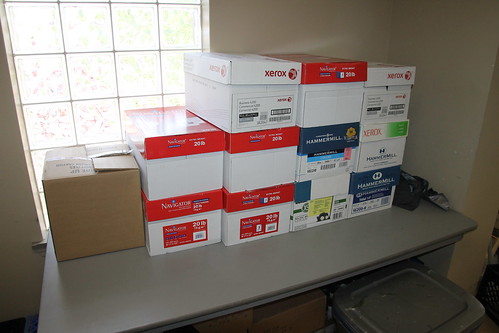
    In June 2015, the Kresge Library wrapped up our 4th Annual Springtime Food Drive.  As in years past, we collected material from the students, staff and faculty of the Ross Community for local Ann Arbor Area food banks.  This year, we had a late jump on the food drive, but we did receive 25 boxes of food and personal products that were shared with two excellent food banks in the area.

    We ended the drive on Friday June 5th - which was National Doughnut Day.  We will likely try to keep that tradition going.

    There are two good reasons we host a food drive in the spring:
    • While many organizations coordinate food drives around the holidays, hunger is a year round problem. Food drives during the spring and summer are less common, but are critical for food banks’ ability to help families in need.
    • At Ross, nearly 40% of our students graduate every year after Winter Term and many leave Ann Arbor. A food drive is a great way to lighten your load as you head out with your degree in hand, while helping less fortunate people in Michigan.

    Kresge Library Food Drive 2015

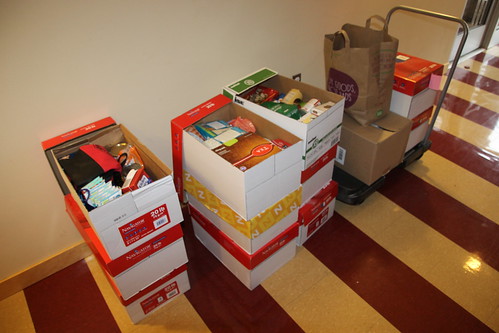
    Here are the 12 boxes of food and personal products that were collected for the Hope Clinic (Ypsilanti, Michigan).


    Kresge Library Food Drive 2015

    Here are the 12 boxes (and one bag) of food and personal products that were collected for Saline (Michigan) Area Social Service.


    337/365/2528 (May 14, 2015) - Kitten Season is Here!  Kittens and Cats at the Crafty Cat Rescue (Ann Arbor, Michigan) - Thursday May 14, 2015

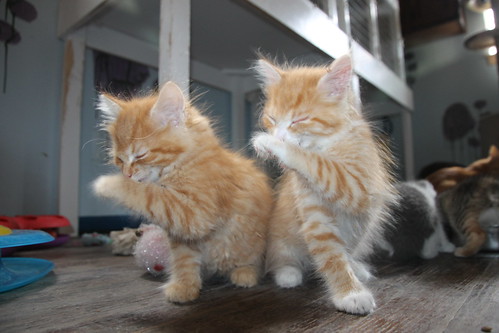
    In addition, we also collected 13 jumbo rolls of paper towels that were given to Crafty Cat Rescue in Ann Arbor, Michigan).  We did not get a picture of the paper towels - but these two kittens did not seem to worry about that!

    A big call out to the Ross Community for participating this year.  Maybe we can make it bigger next year!  

    Monday, May 4, 2015

    Time Travel without a Guide (Greg Bell and Sirius XM)

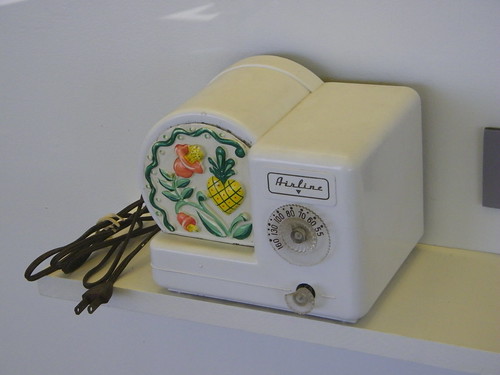
    My Antique Radio
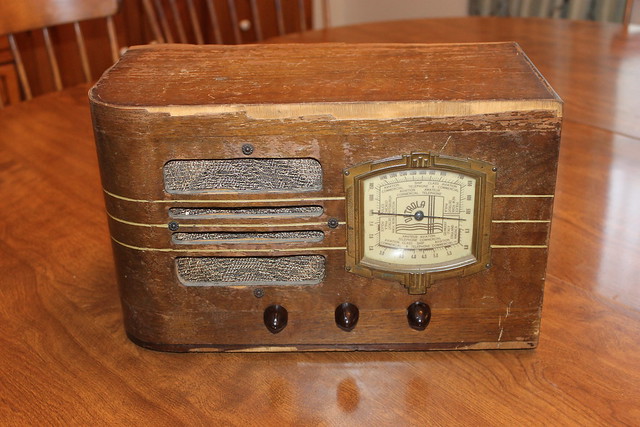
    An Antique Detrola Radio
    It has not been a great week for many fans of Old Time Radio.  But this week seems to be better...fingers crossed.  Time will tell, but this has all the earmarks of a corporate financial play.  Someone was asking for too much money - maybe someone wanted to cut costs.  Not sure what happened on the inside - but it appears to be moving towards a resolution.  That is good news. [NOTE: As of Monday May 4th - it appears that Greg is back on the air - but I am sharing this in case they want to do this again....]

    What was the problem?  It all started out with a simple message on the Greg Bell website:

    "The RadioClassics program schedules for this week are no longer accurate. The line-up and format for the channel are being revised by Sirius XM, and we will update the schedule as soon as we have the correct information. Thanks for your patience. If you have any questions or comments, please reach out to programming@siriusxm.com." - From Greg Bell Media website: http://gregbellmedia.com/ShowSchedules.html


    It became pretty clear that there was a problem.  And if you tuned to the familiar XM Channel 82 (as I had a chance this week since I was able to borrow my wife's car - where we have Sirius XM) you were greeted with something different.  Well, more exactly, something missing.  The host of Channel 82 - Greg Bell.  He was gone.  They still had the ads, they still had the vintage ads, and they still had the programs - but there was no guide.  There was no Greg.  And that was the problem.  Many people voiced serious concerns on the Radio Classics Facebook page (where there are almost 2000 members).  There were a number of complaints and threats to drop the subscription.  I am sure that people will do that - unless things get fixed.  Time will tell.


    The Radio Classics Channel on Sirius XM 82 is a bit unusual.  The entire programming is based on two hour blocks - that often had a them for one or both hours.  These programs were selected to go together.  Maybe they were tied together to showcase the birthday of a performer, writer or producer of radio. Maybe they were tied together to showcase the anniversary of a program - or an event in US history.  Greg Bell even used these blocks to showcase longer series - like Superman and Johnny Dollar Marathons (5-6 episodes in a row).  


    So these programs were not brought together by chance, but curated in the actual sense of the word.  We know this because the station was run by Greg Bell.  He would provide, before and after each episode, commentary about the program, and the actors.  This was wonderful in providing context, especially for people new to Old Time Radio.  And then - the last couple of minutes - we had ads.  I am not sure why there were ads here.  I did not love them.  Some had character - like Big Lou - and others were just annoying - designed to scare who ever was listening. 


    But we ignored the ads - and enjoyed the commentary.  From Greg's commentary, we learned what these programs meant.  What was the back story?  Who were the stars?  Who were the recognizable voice actors?  Basically anything that we really wanted to know.  And for someone like me who was learning all about Old Time Radio through this channel, it was as if we had a tour guide to a time travel adventure.  Also, it was like we had a curator or professor who could take us through these episodes and put them in a broader context.


    I took my inspiration from Greg as I wrote my own blog entries showcasing Old Time Radio.  Recently, I showcased a number of episodes with the background and back story inspired by Greg's commentary:

    And when we forgot what we listening too, we could always go to the show schedules that were online.  When we had road trips, I always had these printed out and ready.  This way we could plan when to listen to XM and when they were playing something we did not like.  In addition, Greg was great about helping people out if they were having trouble tracking down a show.  I sought out his help for a program that was interrupted on my travels up north to Michigan.  It was through work like this that Greg built a community.  People even followed him on a cruise with other Old Time Radio enthusiasts.

    It was from Greg Bell's commentary and selection that I became a huge fan of Johnny Dollar;  that I first learned of the brilliance of Norman Corwin - especially the Odyssey of Runyon Jones;  where I learned about special programs brought to radio by the likes of Orson Welles & Blake Edwards; it is where I learned to appreciate the world of radio programming.  And the funny thing is that most of the Old Time Radio programs are available from places like the Internet Archive and other online resources - at no cost.  But if you walk to the proverbial front door of the collection of Old Time Radio programs on the web - where would you start?  What would you listen to?  This is where you need a guide - a tour guide as it were.  And that is what Greg Bell did day after day - help us understand and put in context these great recordings.  And that is exactly what is missing with the new format.


    Which leads us to change.  Obviously, the fans of Radio Classics voiced strongly that they did not like the new format.  I was able (I hope) to illustrate that above - these views are mirrored by many who posted.  Another channel we listen to - On Broadway XM 72 - would be awful were it not for the hosts Christine Pedi, John Tartaglia, Julie James, and Seth Rudetsky.  (Actually, it would be very awful without Seth).  

    I have noticed recently that with these types of changes, there seems to be this standard approach that is actually making changes more quick and abrupt.  Too many decisions made in implementing change are done in a real authoritarian fashion because of these three commonly held beliefs about our ability to absorb change:

    • Change is hard
    • People complain about any change
    • You will never make everyone happy
    So this gives people the right to 'damn the torpedoes' and move straight ahead.  There are millions of decisions like this - New Coke anyone!  I want to write more about change management - especially with the changes in my career (librarian) - but that is for a later day.

    But this issue shows me that change can be managed better when they involve the people who are the customers - rather than potentially chasing new ones.  Ultimately, we have a market economy. There are many people who like XM 82 and subscribe just for that reason.  They may walk.  Especially since the content is mostly available for free.  


    It sounds like things are working towards a resolution.  But seriously - Greg Bell provides a context for these wonderful recordings that is essentially.  Imagine a museum deciding that most people do not read labels on artifacts - so they are not going to put them up.  From an economic point of view - that might make sense.  But from a mission point of view - it is horrible.  Putting things together with no reason why they were selected is hoarding.  Having something with an explanation of why it is there is curating.  Without a guide - these programs just do not work - and they do not tell us what they can about popular culture in the 1940s through early 1960s.  That is why Greg Bell needs to get back on the air.


    I have been a fan of OTR for some time - and a good number of my favorites I first heard via Greg Bell. Taking his commentary out of the equation does not make any sense. I am not sure if this is a financial problem or not - but I hope they get this resolved soon - before summer driving season!  Just a few days ago, Forbes reported that things at Sirius XM are going well - so hopefully they can figure out this problem and restore things to where they were - and loved.


    CBS Columbia Square (Hollywood, Los Angeles, California) - October 31, 2013
    Columbia Square - Home of CBS Radio during the Golden Years (Hollywood, California)